Affirma Capital’s exit from TBO Tek returned US$468 million in capital gains on about US$42 million invested in 2018 for a 49.9% stake, a 12x multiple and a 49% IRR in dollar terms, DealStreetAsia reported. In rupee terms the figures are 14.9x and 54%.
TBO was founded in 2006 by Gaurav Bhatnagar and Ankush Nijhawan and sells APIs, white-label solutions and dynamic packages to travel agents and tour operators. Affirma sold in tranches: to General Atlantic in 2023-24 at more than 9x, in the May 2024 IPO at about 11x, and in final tranches from July to October 2026 at about 17x the entry price. Five moves sit behind those numbers.
1. It sold only to the trade
TBO has no consumer brand. In Q1 FY27 it served 33,736 monthly transacting buyers, up 14%, and gross transaction value reached INR 11,154 crore, up 37%. Every one of those buyers is an agent or operator, not a traveller.
That choice removes channel conflict. A hotel or airline that supplies TBO is not feeding a rival to its own direct site, so it can open more inventory to the platform. For an OTA or DMC, the lesson is that a trade-only business can be sold to suppliers as pure incremental demand.
2. It earned its money abroad
In Q4 FY26, international business was INR 716.3 crore, or 88% of revenue, against INR 98.1 crore, or 12%, from India. International monthly transacting buyers rose about 50% to 14,944, while India had 17,806.
A company with more buyers at home than abroad still booked nearly nine rupees in ten overseas. Hotel GTV grew 56% in Asia Pacific and 37% in Europe in Q1 FY27. Hotels in APAC should read that as proof that a platform headquartered in India can move room nights across borders at scale.
3. It bought hotel supply
TBO bought 100% of Jumbonline, the online business of Jumbo Tours Group, announced on 21 December 2023. The deal gave access to 120,000+ hotels, 15,000 of them directly contracted. Bhatnagar said it brings “quality content from across prime destinations in Europe right down to the Caribbean”, Travolution reported.
Direct contracts carry better rates and control than rented content. In Q1 FY27, hotels and ancillary GTV was INR 75 billion, up 50%, while airlines were INR 35 billion, up 17%. Hotels are growing roughly three times faster than flights on the platform, which tells hoteliers where TBO’s trade buyers are spending.
4. It bought Classic Vacations to enter US luxury
TBO completed the US$125 million acquisition of US luxury wholesaler Classic Vacations on 1 October 2025, Inc42 reported. Classic had FY2024 revenue of US$111 million and operating EBITDA of US$11.2 million, and CEO Melissa Krueger stays on.
The deal bought a profitable business with its leadership intact. Organic GTV excluding Classic was INR 9,918 crore, up 22%, and integration is expected to be substantially complete by Q3 FY27. For luxury hotels in Asia, a wholesaler with US relationships is a new route to high-spending American guests.
5. It let the market take the shares in stages
In March 2025, Augusta TBO and TBO Korea Holdings sold a combined 6.8% for INR 870 crore at INR 1,200.02 a share. Nippon India, SBI and ICICI Prudential mutual funds bought INR 537 crore of it. On 14 July 2026, Affirma sold 2.04%, or 21.8 lakh shares, for INR 327.5 crore, taking its holding from 5.54% to 3.5%.
The buyers were domestic funds, and the business gave them numbers to hold. FY26 revenue from operations was INR 2,677.4 crore, up 54%, and net profit was INR 244.3 crore, up 6.3%. Q1 FY27 added revenue of INR 925.8 crore, up 81%, and net profit of INR 83.4 crore, up 32%.
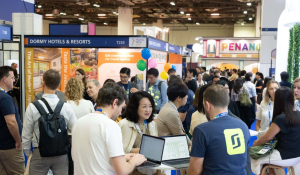
Who to watch: co-founders Gaurav Bhatnagar and Ankush Nijhawan, whose business model will be a live topic at ITB Asia from 21 to 23 October for any B2B platform, DMC or tourism board looking for APAC distribution.
Key takeaway
TBO grew by choosing one customer, the travel trade, and then buying what that customer needed: hotel contracts in Europe and a luxury wholesaler in the US. We would copy the order of operations. Pick the buyer first, own the supply second, and let revenue outrun profit only when each acquisition adds contracts or margin that the platform did not have.