Routavio maps the last leg: 175,000 active users in four weeks
Türkiye-built Routavio plans trips across flights, trains, buses and ferries, and reports about 175,000 active users in four weeks, per its founder.

4 min read

Routavio, an independent multimodal journey planner built in Türkiye, counted roughly 175,000 active users between 11 September and 8 October 2026, according to Google Analytics 4. Founder and product lead Halil Çınar shared the figure in written answers to TravHQ’s five startup questions. This profile draws only on those answers and on the Routavio website.
How Routavio started
The product is aimed at independent travellers who want to arrive at a real destination rather than the closest airport. Çınar points to smaller cities, coastal towns, mountain destinations and trips with several stops in Europe. His example: a flight can deliver a traveller to Venice, yet Padua may still call for a train or coach. Those onward legs are usually researched piece by piece on separate sites.
Türkiye, he says, is a natural place to see the gap. Getting to a destination there often means passing from international air travel to local buses, rail or ferries, and Europe has the same patchwork across its borders. The team chose to treat multimodal search as one connected route-planning question instead of assuming a single flight or a single booking platform tells the full story of a trip.
What Routavio looks like
A search compares whole routes built from flights, trains, buses and ferries, with transfers and total journey time counted in. Travellers can rank results by duration, price, number of changes or an overall balance of the three. The site lists more than 50 countries and four transport modes. Flights are covered worldwide, while ground routes sit mainly in Europe and Türkiye.
Routavio is not a ticket seller. Travellers complete bookings with independent third-party providers, which confirm the final price and availability. Çınar says the service neither sells tickets nor handles payments. Some fares on screen are previously observed estimates, so the provider’s page has the last word on what is available and what it costs.
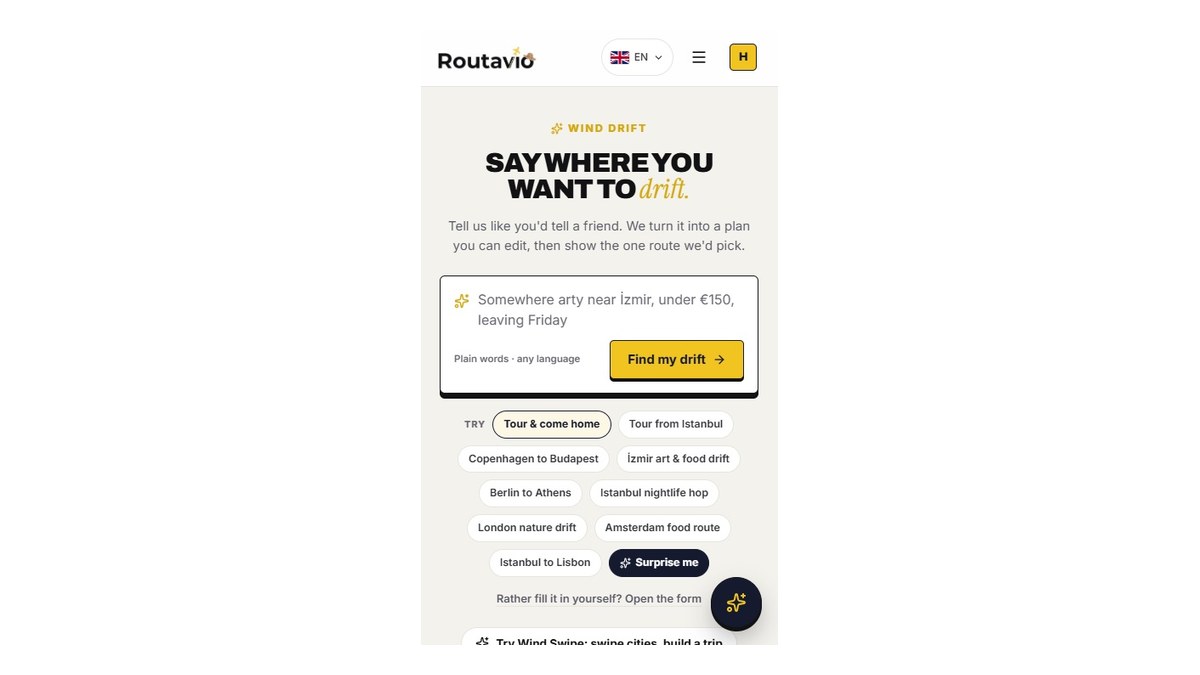
Wind Drift, the startup’s natural-language feature, converts a single sentence into scored door-to-door routes. Çınar’s sample request asks for something artsy near Izmir, under €150, leaving Friday, with no long layovers. The aim is to turn such preferences into a structured search so the traveller does not have to fill in every field first. A second feature, Wind Swipe, gives a more visual way to browse destinations.
Çınar sets Routavio apart from established booking platforms such as Omio, which he describes as a mature place to search and buy transport. His product sits earlier in the process, at journey discovery. Where no direct flight exists, it looks at possible arrival airports and the ground or ferry links beyond them, then lines up the combinations for comparison.
The business behind Routavio
Çınar was careful to say that his usage figures come from different tools and cover different periods.
- Google Analytics 4 logged about 175,000 active users and 655,000 events from 11 September to 8 October 2026.
- Similarweb Pro put September 2026 at 96,671 visits, and the 28 days to 8 October at 179,530. Those are visits rather than unique people, and Similarweb measures differently from GA4.
- Over one recent 30-day stretch, PostHog showed around 21,486 journey searches begun, 18,954 views of a results page and 4,104 clicks onward to booking providers.
Those outbound clicks are the commercial signal Çınar highlights, because Routavio takes no payment itself. On content, the catalogue covers roughly 1,194 cities and 31,732 flight origin and destination pairs, with route pages localised into 10 languages. He adds that the catalogue size says nothing about live ticket stock on every route, and that dated screenshots or source reports exist for each number he gave.
Çınar leads the product. The service is built independently in Türkiye by a small circle of collaborators working on engineering, transport-data integration, product research and international outreach. The answers make no mention of outside funding.
The next twelve months
The first priority is a stronger, more dependable core route planner. In practice that means broader rail, bus and ferry coverage, better access to real-time data and fresher prices, a smoother handover to booking providers, and sharper multi-criteria routing for complicated trips. Wind Drift and Wind Swipe will keep developing as companion ways to find destinations and connections. Growth beyond today’s European and Turkish ground-transport focus is described as a longer-term ambition.
Key takeaway
Routavio treats the stretch between an arrival airport and the actual destination as a search problem that travellers still solve by hand. Hotels, tourism boards and OTAs in secondary cities should test how easily a guest can see the final leg of the journey to them, because that is where a booking can slip away. Founders can also borrow the way Çınar reports traction, with every number tied to its tool, its period and its limits.
Building a travel startup? TravHQ wants to hear your story. Pitch it to TravHQ.
Topics in this story
Daksh Sharma
Chief Editor, TravHQ
Daksh Sharma is a travel tech enthusiast and a prolific voice in the B2B travel industry. A speaker at numerous travel-tech events, he is at the forefront of digital and AI adoption in travel. He conducts AI training and implementation programmes and works as a digital advisor to a number of global B2B brands.
More from DakshHave a story Daksh should see? Write to editor@travhq.com.